
A comprehensive guide to the history, working standard and anatomy of the world's only specialized truffle dog.
The only breed in the world anatomically and instinctively specialized exclusively in finding truffles.
Retrievers, Flushing Dogs and Water Dogs · Water Dogs · Standard No. 298
The Romagna region and the Po river delta – originally a water retriever from the marshes.
A healthy, long-lived breed – with responsible breeding and an active life.
Females 41–46 cm.
Females 11–14 kg.
The hunting drive was suppressed over generations of selection in favour of scent work.
From the Etruscan marshes to international recognition
Paintings in the Spina Necropolis depict curly-coated dogs morphologically identical to today's Lagotto.
Andrea Mantegna depicts a Lagotto in a fresco in the Camera degli Sposi in Mantua, confirming the breed's historical continuity.
The draining of the marshes in the Romagna region turns the original water retriever (Càn Lagòt) into a truffle specialist.
Romagnol cynologists reconstruct a purebred line. In 1988 the Club Italiano Lagotto (C.I.L.) is founded.
The breed is recognized by the Fédération Cynologique Internationale (FCI).
Every detail of the body serves work in demanding terrain
Nearly half the length of the head, with wide nostrils for maximum intake of scent molecules from under the ground.
A waterproof undercoat and dense curls historically protected the dog from icy marsh water – today from thorns in the forest.
Distinctly developed interdigital webbing is a legacy of the water dog – today it helps with movement in muddy terrain and digging.
Body length equals height at the withers. The compact, strong build provides endurance for a full day's work in demanding terrain.
Carried joyfully raised while working, it serves as a visual signal for the handler. It must never be curled into a tight ring.
A woolly texture, semi-rough on the surface, with tight ring-shaped curls and a visible undercoat. The hair on the head is looser, forming eyebrows, whiskers and a beard.
The Lagotto doesn't have fur but hair, which grows continuously and doesn't shed. Dead skin cells and allergens remain trapped in the curls until they are combed out or clipped.
Off-white, brown (various shades), orange, roan, often with white. Historically, light colours were preferred for better visibility of the dog in the forest at dusk.
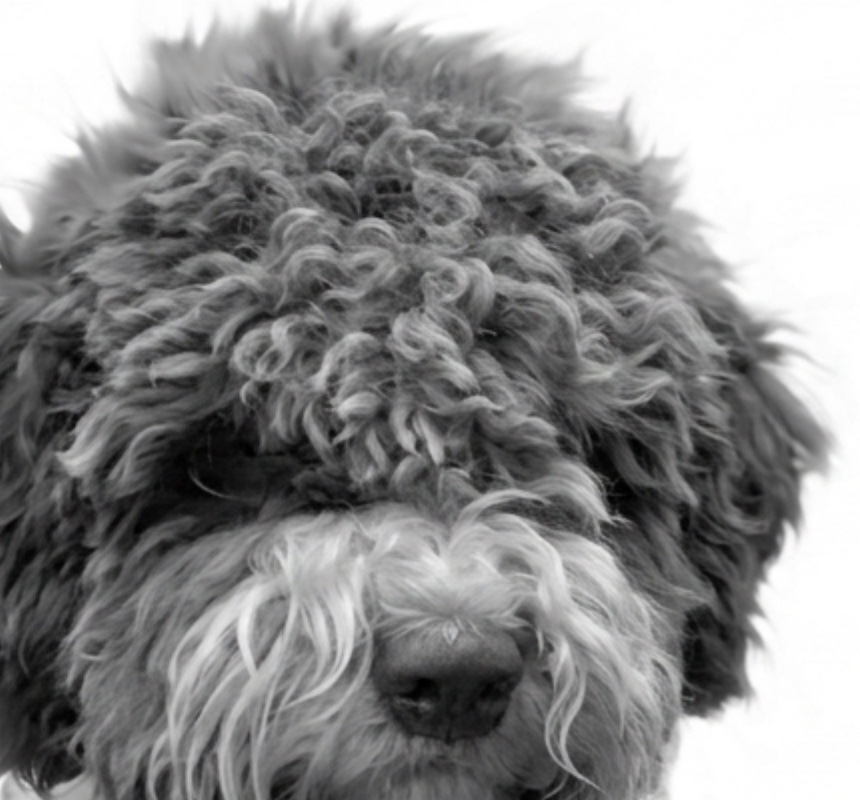
Thorough combing to prevent felted mats from forming – especially behind the ears and in the armpits.
The Lagotto is prone to hair and wax build-up in the ear canal. Ear hair must be plucked regularly and gently to prevent infections.
The coat must be completely clipped at least once a year.
An exceptionally bright dog that is constantly looking for a "job". It learns quickly, but without mental stimulation it will invent its own entertainment – often a destructive one.
So the dog wouldn't be distracted by game while searching for truffles, the hunting instinct was completely suppressed over generations of selection. The Lagotto does not chase game.
It works autonomously but constantly keeps in touch. It loves its family, though it may initially be reserved with strangers.
An excellent, alert watchdog that announces any change with barking. Note: some lines can be prone to shyness if not thoroughly socialized at an early age.
The three phases of a truffle dog's work
The gait is a fluid, energetic trot. The search proceeds in diagonal lines – the dog meticulously "criss-crosses" the terrain with its nose to the ground.
A joyful, eager expression; the tail wags faster when scent is caught. The animal ignores any scent of game.
Once the dog pinpoints the truffle, it starts digging vigorously. The key test: the dog must stop digging immediately on the handler's command, so the truffle can be safely lifted without damage.
Introducing the puppy to various surfaces, sounds and forest terrain to build absolute confidence.
Using natural curiosity through scent games – teaching the dog to use its nose instead of its eyes.
Pairing the scent of a real truffle (or a natural essence) with a positive reward. The dog learns to indicate the find without eating the truffle.
Moving into cultivated and wild truffle grounds. Training concentration and systematic searching in real, distracting conditions.
Ethical Lagotto Romagnolo breeding requires strict DNA screening and screening for physical anomalies before a dog enters a breeding programme.
Seizures in puppies (5–9 weeks). The rule: a Carrier may only be mated to a Clear dog. Affected dogs are never bred.
A fatal neurodegenerative disease. DNA testing is absolutely essential before any mating.
X-rays for hip and elbow dysplasia. Only grades A or B (OFA: Excellent/Good/Fair) are accepted for breeding.
Annual screening by a certified ophthalmologist for hereditary eye defects (cataract, distichiasis).
The Lagotto is not a couch dog. It is an enduring worker that needs structure and employment – otherwise it will find a job on its own (for example, redesigning your garden).